



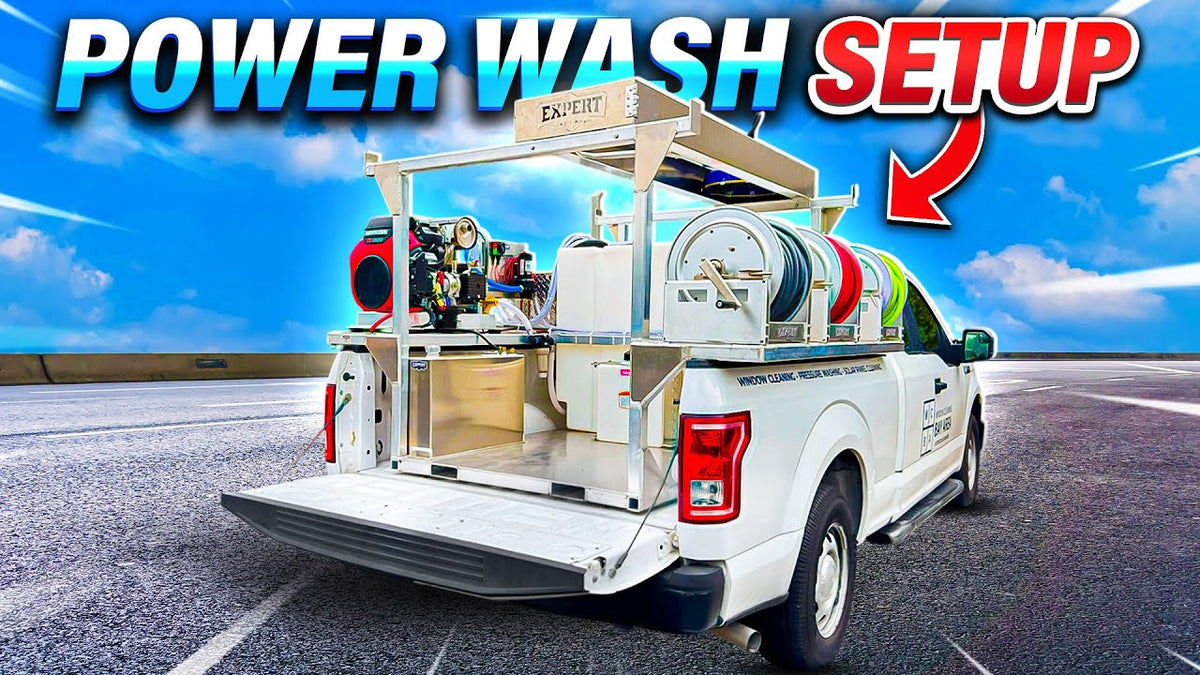
Anyone can show you a finished skid. What decides whether it is still earning money in year five is a hundred small choices you cannot see in a photo. This is a full walkthrough of a 6.5 ft Workhorse skid we built, component by component, with the reasoning behind each one.
The three things we design for, in order: proper layout, serviceability, and reliability. Anyone buying a rig like this is working off it eight to ten hours a day. It has to make money, not cost money.
The frame
Quarter-inch aluminum. The industry standard, last time we checked around, is about an eighth. We have had plenty of those thinner skids come through our shop for repair, and our fabricator has braced them back up.
Beyond thickness: gussets on the corners, gussets down the sides, and on the shelf — which carries real weight — we did not stop at a gusset. We cut the same 2 inch quarter-inch square tube at 45 degrees and welded it in, so the shelf is double gusseted.
Our fabricator is a former welding instructor who taught people how to weld. Every aluminum skid we build carries a lifetime guarantee against breaks and cracks. To date none has ever broken, and if one did we would fix it here or connect you with a fabricator local to you.
The machine
An 8 GPM gear drive unit on a heavy-duty aluminum plate, running a General Pump TSF 2021.
The unloader is the part worth understanding
On most machines the unloader hangs off the back of the pump. Ours is block mounted — relocated off the pump onto its own block. Constant pump vibration is what kills unloaders, and a block mount takes that stress out.
It is also a flow-sensitive unloader, and a genuinely expensive one. Most production machines ship with something around a $65 unloader. This is a $300 part. What you get for that is no trapped pressure: pull the trigger and you do not get a violent jerk and a burst of backed-up pressure through your hands. If you work at height, or you are running a drone setup, that matters a great deal more than it does standing on a driveway.
It sits on a bypass, so off the trigger the water recirculates back to the tank. That gives the machine a large circulation loop and stops it overheating.
The rest of the machine
- Honda exhaust. A lot of production machines ship with a silver aftermarket exhaust. Those work, but they are off-the-shelf parts on off-the-shelf machines. This one is custom built throughout.
- Key start, oil filter, hour meter, and a fuel pump behind the plate drawing from the tank.
- An oil drain line routed to the side of the skid. Pull it off the side, drain, done — no oil down the frame every service.
- 13 gallon slim aluminum fuel tank with brass fuel barbs and a rollover valve, so the tank can pull air in without spilling fuel.
- 80 mesh stainless filter on the intake, drawing from the bottom of the tank. Every drop entering the pump is filtered. Sediment in a pump is premature maintenance you should never have to do.
Fittings and the backup plan
All stainless steel — no zinc, no brass, both of which we see constantly on other setups. Crushproof hose. Full-stainless clamps, including the screw, sourced from the UK; they cost more and they do not leak.
Everything is on quick connects. Most builders plumb the crossover line straight into the block, which is fine until that line bursts and the rig is dead. With quick connects you pull it and hook your pressure hose directly into the machine, and you finish the day.
The soft wash system
A 5.5 GPM Remco dual control pump, which is built specifically for soft wash. Be careful here if you are sourcing your own: the water-only version of that pump looks identical from the outside. We regularly see people buy the cheaper one because they are comparing on price and cannot tell them apart.
Wiring and fusing
All upgraded, larger gauge, pure tinned copper strand. Not the wire sold cheaply online with filler material in it — you will not get your voltage through that on a long run, and the pump will look like it is failing when the problem is the wire.
Marine-grade switch. USA-made fuse holder with a Bussman fuse inline. Remco specifies a 30 amp for these pumps, so that is what goes in. One cheap switch or one cheap fuse holder can take the whole system down, so there is no point building everything else properly and then economising there.
The tanks, and why there are no bulkheads
Two 100 gallon slim tanks — one water, one bleach — plus a 7 gallon soap tank on a thick 316 stainless bracket. The tanks are heavy duty enough that you cannot push the walls in by hand. Earlier versions in this industry were thin enough to belly out every time you filled them. These are not those.
Vented lids on both sides, so you can top up or run a second garden hose when you are going through water fast.
Now the part most people will not show you — inside the tank:
- No metal in the tanks, at all. Liquid breaks metal filters down over time, and bleach does it fast.
- The hose runs directly through the tank wall on a seal rather than through a bulkhead. A bulkhead gives you a cracking point top and bottom, and bleach will find them eventually. Running the hose through eliminates those failure points entirely.
- A slotted PVC filter held down by a length of PVC so it cannot float to the top. A floating filter pulls air, and 12V soft wash systems hate air.
There is a 1 inch drain on the tank that runs to the outside, so you can dump water off the side of the tailgate rather than hauling the weight around. It doubles as a hand wash or eye wash on the job, which you will appreciate exactly once and never forget.
A Hudson float valve shuts the fill off automatically when the tank is full.
The reels
Three 12 inch Expert full-frame aluminum reels. Not powder-coated steel — powder coat chips, and on a soft wash rig it starts rusting the moment it does.
On a cheap reel, the pipe running through the drum is steel. Ours is 316 stainless, as are the handles and the swivels. The industry standard is 304; we upgraded everything to 316 last year, including all the mounting hardware on the skid.
On a 6.5 ft skid the handles are tight, so the layout is meticulous — each handle winds fully without fouling the next one.
| Reel | What is on it |
|---|---|
| Pressure | 200 ft of FierceJet hose (two 100 ft sections), stainless fittings, a ball valve swivel, a Mosmatic swivel and a genuine Italian DN10 ball valve |
| Soft wash | 200 ft of 1/2 inch Soft Jet hose, crimped ends, a Suttner ST-510 gun and a J-Rod with four stainless nozzles matched to the pump |
| Garden | 100 ft of 3/4 inch Flexzilla with a whip line underneath for quick detach |
A few notes on those choices:
- The FierceJet hose is rated at 4,250 PSI working and 10,625 PSI burst, and it is one-wire, so it is still easy to drag. People do not believe those numbers until you show them the jacket.
- The Mosmatic swivel is a $60 to $70 part. There are lookalikes online at $25 to $30. We would rather not take the call where something broke in month three.
- Stainless nozzles, never brass. Bleach eats brass nozzles.
- 3/4 inch garden hose, not 5/8. Larger diameter fills your tanks measurably faster, and filling is dead time.
More on that last reel in the garden hose kink at your reel, and how we fixed it.
The mixer
The soft wash mixer is the brains of the system, and this one has a rinse valve that brings fresh water into both sides.
Here is why that matters. Most people rinse by shutting the chemical and soap valves and pulling water through. That flushes the pump and the hose — but it does not flush the bleach line itself. Leave 12.5% sodium hypochlorite sitting in that line and it eats that whole side of the mixer. Bringing water into both sides rinses properly and gives you better flow while you are doing it.
If the mixing station still looks like a wall of unlabelled knobs to you, start with how a soft wash mixing system actually works.
The box, the rack, and the space you keep
The EPW box is heavy-duty aluminum, made in the USA, with stainless hinges and a stainless locking mechanism. There are similar-looking boxes online for a couple of hundred dollars. This is not one of them. Inside: a marine-grade Interstate battery, the fuse holder, and tidy heavy-gauge wiring.
There is a surface cleaner rack with the keys zip-tied on so they do not walk. This customer chose a Whisper Wash 19 inch Classic, which is what we point people toward when they are buying one surface cleaner.
One layout point that gets overlooked: we deliberately leave bed space. It is easy to fill the whole footprint of a skid with equipment, and then your truck is no longer a truck. Ours are laid out so there is room left for blowers, garbage cans, gutter guards — whatever your business actually involves.
A note on the trailer version
The same build quality goes onto our Eagle Series trailers. Those are custom built to our spec rather than pulled off a lot — a 6x10 dual axle, because most people starting out want to park it in a garage and a 12 ft trailer will not fit. Built-in reel rack welded into the frame, the same 2 inch square tube used for tank mounts, and mounting tabs on both sides of each tank strap rather than the single tab everyone else uses. Electric reels and an electronic downstream system are options.
Come see one
We are at 13896 S Fir St Suite B in Oregon City, just south of Portland, Monday to Thursday 8am to 4pm. People stop in and tour the shop regularly — the store is fully stocked with the same parts that go on these builds, so you can see the components rather than take our word for it.
See our skid and trailer builds, read why they are built this way, or book a free discovery call and we will spec one around the work you bid.


