



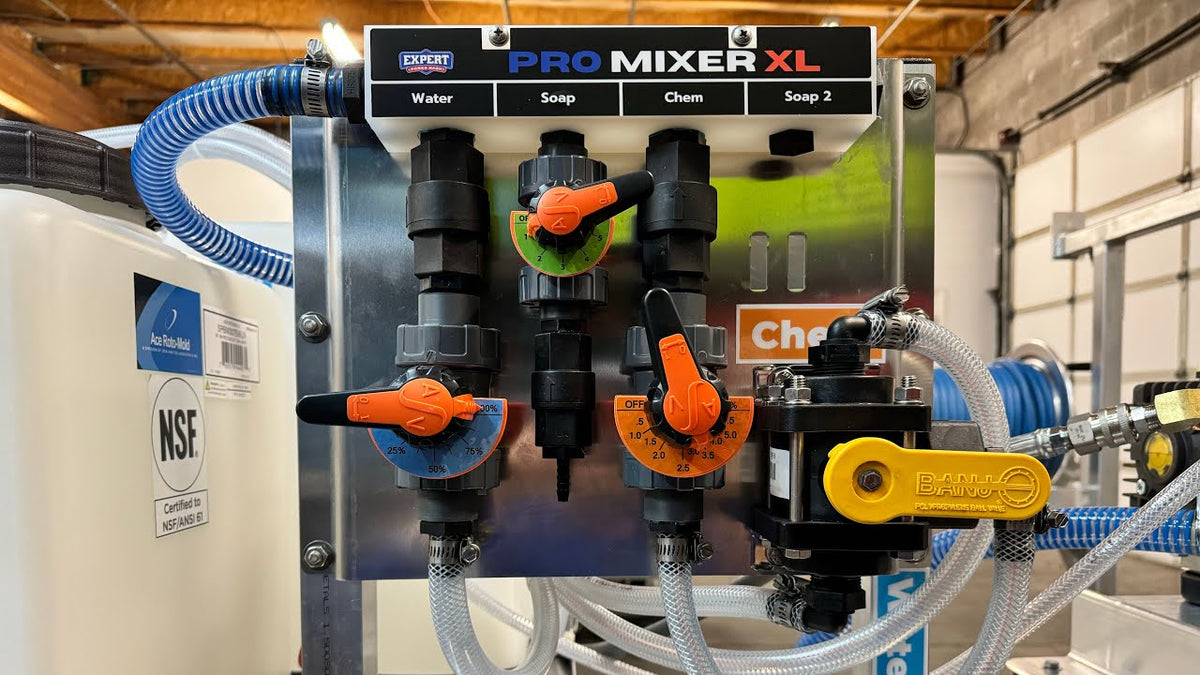
We build a lot of soft wash systems, and the most common question we get is not about price — it is "what do all these knobs do?" A mixing station looks complicated until someone walks you through it once. This is that walkthrough.
Start with the simple version: batch mixing
The simplest soft wash setup is four parts: a 12V pump, a battery with a charging system, a hose reel, and a gun. The pump's outlet runs up to the reel, out to the gun, and you spray. The inlet drops a slotted PVC bleach-resistant filter into whatever tank you are using.
That is batch mixing. You decide the ratio in the tank — a lot of people run something like half water, half bleach for a roof — add surfactant, drop the pickup in, and go. It bolts onto a trailer, an existing pressure washing setup, or the bed of a truck, and for a lot of residential work it is all you need.
One warning on pickups. If your drop filter has a hose clamp on it, take it off before it goes anywhere near bleach. We pull them off any unit that comes through the shop with one. A clamp sitting in sodium hypochlorite will ruin the bleach in the tank.
The step up: a three-tank metering system
Batch mixing means re-mixing every time the job changes. If you do not want to stand there working out how much bleach and soap to put in the tank before every roof, you move to a metering system with three tanks: water, soap and chemical.
Now the pump pulls from all three at once through a manifold block, and you set the ratio with metering valves instead of in the tank. Change the dial, change the mix, no dumping and refilling.
What each valve does
| Valve | Where we usually run it |
|---|---|
| Water | 100% open, always |
| Soap / surfactant | Around 1, or slightly under |
| Chemical — siding and house washing | About 1; a heavy pre-treat or post-treat can go 1.5 to 2 |
| Chemical — roofs | Depends entirely on your region. Much of the Midwest and East Coast can wash a roof well below 2. Here in the Pacific Northwest we run our mossy roofs between 5 and 6. |
Be careful not to oversaturate. Higher is not automatically better, and the numbers above are our settings on our systems — treat them as a starting point, not gospel.
The three-way rinse valve
The valve that confuses people most is the three-way. It has two water ports feeding it: one goes to the water side of the mixer, the other to the rinse side of the bleach valve. Select chemical and it pulls chemical through the mixer. Flip it to water and it pulls water through the same path, which flushes the chemical side of the system out. That is the whole trick — it lets you rinse the system without dismantling anything.
How we plumb the tanks
A few things we do on every build, because they are the difference between a system that lasts and one that leaks:
- Two water tanks tied together with an inch-and-a-half hose and 90 degree barbs through bulkheads. Two smaller tanks baffle the water against each other and cut sloshing compared with one big tank.
- Uniseal and straight-through plumbing from the tank down to the pickup — no unnecessary bends restricting flow.
- Slotted PVC bleach-resistant filters on the pickups, with a length of PVC holding them near the bottom so the line cannot suck air.
- No hose clamps anywhere in the bleach.
- Kuri Tec poly braid hose throughout, not bulk cheap braid.
- A marine battery. Marine batteries are built to be run down and recharged repeatedly, which is exactly what a soft wash pump does to them.
Guns and nozzles
We run Suttner ST-510 guns with 1/2 inch hose crimped on rather than barbed and clamped. You can do it the cheaper way, and plenty of people do, but barb-and-clamp joints are the ones that turn into failure points a year later.
On the J-Rod you will typically carry a 0, 15, 25 and 40 degree tip. Do not match nozzles by eye because you like the look of them — they have to be dialled to the system. Run 3.0 nozzles on a big 8 GPM pump and you will blow fuses; run 40s on a 5.3 and you will lose distance. See choosing the right nozzles for your 12V soft wash system.
Build it or buy it
You can assemble a working system from parts — we sell all of them. Shop soft wash mixers, metering valves, 12V pumps, buffer and chemical tanks and fittings and plumbing.
Or have it built. After a few hundred of these we have settled on what works and what fails, and every build comes with training on your own rig. See our builds or book a free discovery call.


