



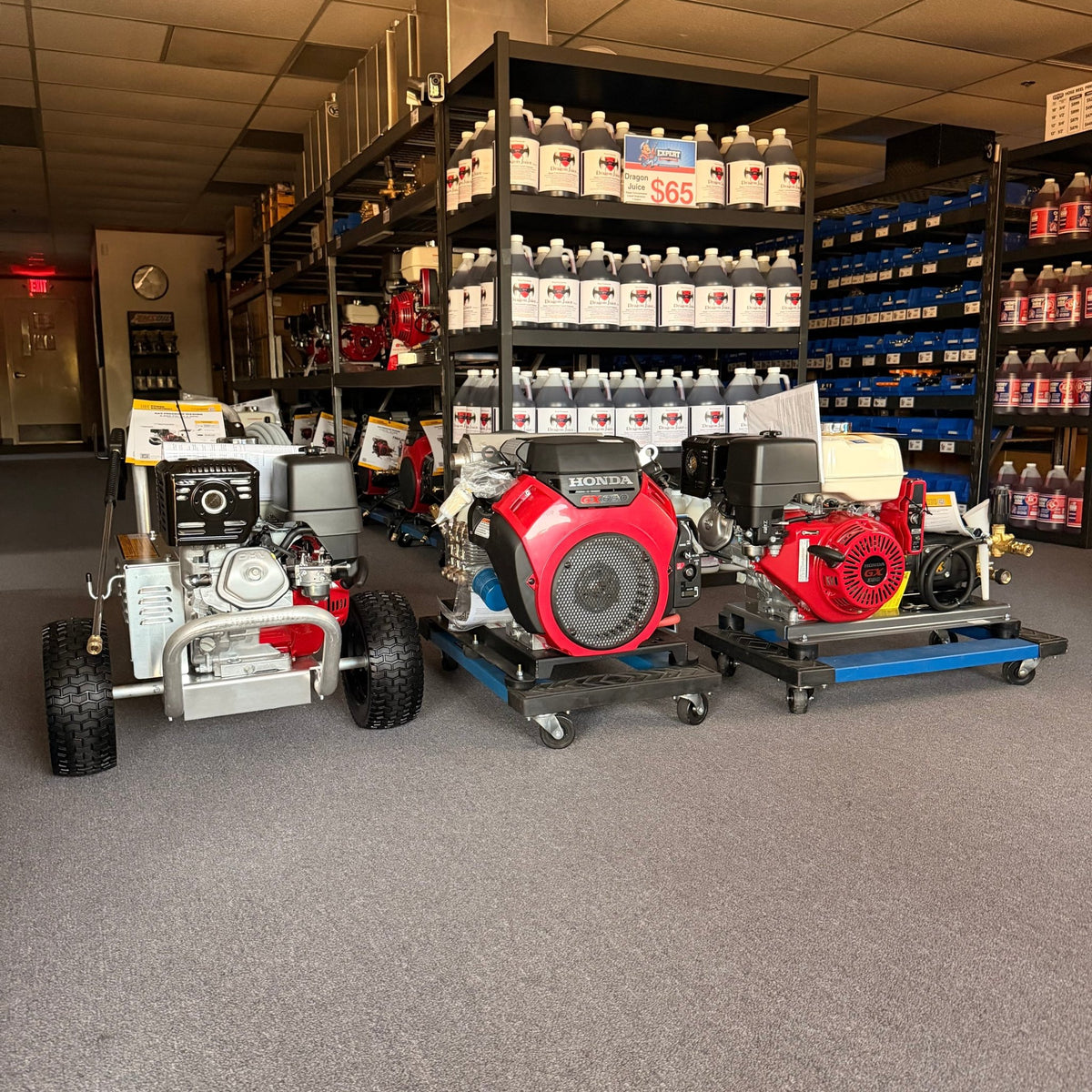
Short answer: For most solo residential pressure washing businesses, a 5.5 GPM belt-drive machine is the sweet spot — fast enough to be profitable on house washes, driveways, and roofs, without demanding a huge buffer tank or budget. Go 4 GPM if you're starting on a tight budget or working mostly smaller residential jobs. Step up to 8 GPM when flatwork and commercial accounts are a real part of your plan — not a someday dream.
That's the answer we give across the counter every week. Here's the reasoning behind it, from a crew that ran these machines on our own trucks for over a decade before we started building rigs for other people.
GPM vs. PSI: Get This Straight First
Most new buyers shop by PSI because that's the number plastered on every machine at the box store. In this industry, PSI is mostly a solved problem — nearly every professional machine puts out 3,000–4,000 PSI, and for soft washing you're turning pressure down anyway.
GPM — gallons per minute — is what you're actually buying. GPM is water volume, and water volume is rinsing power. It's what pushes dirt off the driveway, carries detergent up the wall, and rinses a roof before your chemical dries. More GPM means the same job gets done faster. And since you sell your time, GPM is directly tied to how much money you make per day.
What Changing GPM Actually Changes
Job speed. The rule of thumb that held true on our own crews: going from 4 GPM to 8 GPM roughly cuts your rinse time in half on flatwork and large surfaces. A driveway that takes an hour at 4 GPM is a 30–35 minute job at 8.
Your water supply. This is the one nobody warns you about. A typical residential spigot supplies somewhere around 5–8 GPM on a good day — and plenty of houses on wells or older plumbing supply less. A 4 GPM machine can usually run straight off the customer's spigot. An 8 GPM machine will outrun most spigots, which means you need a buffer tank feeding the machine while the spigot refills it. That tank adds weight, cost, and footprint to your rig.
Your whole build. Machine size cascades through everything: a bigger machine means a bigger buffer tank, which means more water weight, which can mean a heavier-duty trailer, bigger axles, and larger hose. This is why we always say pick your machine before you pick your platform — we walk through that decision in our skid vs. trailer vs. van guide.
Price. Real numbers from our own shelves, not made-up ranges: cold water 4 GPM machines run roughly $1,400–$2,000, 5.5 GPM machines roughly $2,000–$3,000, and professional 8 GPM machines $4,800–$5,000. Hot water at 8+ GPM puts you north of $8,000.
4 GPM: The Starting Point
A 4 GPM / 4,000 PSI machine is the classic entry point for a reason. It's affordable, it runs off most residential spigots without a big buffer tank, and it will absolutely handle house washes, decks, fences, and smaller driveways. If your first year is going to be residential work while you build a customer base, a 4 GPM machine with a Honda GX390 engine and a real triplex pump is honest, dependable equipment.
Where it falls short: flatwork. Big driveways and any commercial concrete will feel painfully slow, and slow work either eats your margin or prices you out of jobs. If you already know concrete is a big part of your plan, don't start here.
From our catalog: the 4.0 GPM Honda GX390 with Comet triplex pump at $1,399, or the 4.0 GPM Honda GX390 with General triplex at $1,999.
5.5 GPM: The Sweet Spot for Most Businesses
This is the size we recommend most often for solo residential operators. A 5.5 GPM belt drive gives you a real speed advantage over 4 GPM, runs cooler and lasts longer than direct-drive machines, and only needs a modest buffer tank — a 100–200 gallon tank covers most homes' supply gaps without turning your trailer into a water hauler.
One upgrade we push people toward at this size: electric start. When you're starting a machine a dozen times a day, every day, pull-starting gets old fast — and a machine you dread starting is a machine that slows you down. We put electric start on our own builds for a reason.
From our catalog: the 5.5 GPM Honda GX390 CP belt drive at $1,985, or the electric start 5.5 GPM belt drive with Centurion pump at $2,999.
8 GPM: The Production Machine
An 8 GPM machine is a different class of tool. It's the machine for flatwork, large commercial accounts, and HOA contracts. The Honda GX690-powered units we sell move enough water that concrete cleaning stops being a grind and starts being a production line.
The honest trade-offs: an 8 GPM machine will outrun nearly every spigot, so a buffer tank isn't optional — plan on 200+ gallons minimum, and understand what that water weighs (roughly 8.3 lbs per gallon — a full 275 gallon tank is over 2,200 lbs before you've loaded anything else). Your trailer, axles, and tires all need to be specced for it. And the machine itself costs three to four times what a 4 GPM does.
Who shouldn't buy one: the brand-new solo operator doing house washes. We watch people over-buy this machine every year because bigger feels safer. Then they spend their first season hauling around 2,000 pounds of water they don't need, on a trailer that cost more than it had to. Buy the 8 when the work demands it.
Our Recommendation If You're Serious About Growing
You can get away with a smaller machine — plenty of profitable businesses run on 4s and 5.5s. But if you're serious about growing a pressure washing business, here's the exact machine we recommend: a gear drive Honda 8 GPM, 3,500 PSI pressure washer with a Pulsar flow-sensitive unloader. That's not a generic spec — it's how we set up our own machines, and there are a few details in it that matter.
The unloader comes off the pump. A lot of machines ship with the unloader mounted directly on the pump, where it lives with constant vibration — and vibration is what kills unloaders. We block mount ours instead: a much stronger mount with far less stress on the unloader. We also run an oversized pressure line from the pump to the unloader — the unloader whip line — instead of the undersized plumbing most machines come with. (Once it's mounted, make sure it's dialed in — here's how to adjust your unloader the right way.)
The charging system matters more than people think. We build these on a custom base plate with an upgraded charging system that keeps your 12V battery topped up while the machine runs. Here's why that's a big deal: most soft wash systems run off that same 12V battery — usually a marine-grade battery — so a pressure washer that recharges the battery all day means your soft wash system never dies on the wall in the middle of a job.
That exact setup is in our catalog: the Honda GX690 8 GPM gear drive with blocked Pulsar unloader at $4,999. We also stock the BE Honda GX690 8 GPM gear drive at $4,999 and the BE Honda GX690 8.2 GPM belt drive at $4,799, and for high-volume operations, a 10 GPM electric start Honda IGX800 belt drive at $4,999.
The Setup That Scaled Our Business
Our sweet spot, honestly? A two-man crew on a skid with two 8 GPM machines — each machine running its own gun. That rig is a beast on commercial work: parking lots, parking garages, multifamily, senior living centers, and large commercial properties. That's where the big money is in this industry, and it's exactly the work we focused on as we grew. Two 8 GPM machines were a game changer for our business — we were doing far more work in a short amount of time, and it's one of the reasons we were able to scale as fast as we did.
The one thing to watch with a two-machine rig: water supply. Two 8s drink 16 gallons a minute between them, so you have to make sure enough water is flowing into your machines. Dual-feeding the buffer tank — running two supply lines into it at once — was something we did on jobs all the time to keep up with demand.
Side by Side
| 4 GPM | 5.5 GPM | 8 GPM | |
|---|---|---|---|
| Price (cold water) | $1,400–$2,000 | $2,000–$3,000 | $4,800–$5,000 |
| Buffer tank | Usually optional | 100–200 gal recommended | 200+ gal required |
| Best for | Startup budgets, house washes, smaller residential | Most solo residential businesses | Flatwork, commercial accounts, big production days |
| Watch out for | Slow on big concrete | Skip pull start — get electric start | Water weight, trailer capacity, cost |
Our Honest Take
We're not going to pretend the answer is always "buy the biggest machine we sell." It isn't. The most expensive mistake we see isn't under-buying — a 4 GPM machine that's earning money can pay for its own replacement. The expensive mistake is buying a machine that doesn't match the work: an 8 GPM rig hauling water to $250 house washes, or a 4 GPM machine grinding through a parking garage bid.
Match the machine to the jobs you'll actually book in your first year, and make sure the supporting pieces — tank size, plumbing, hose, and platform — are built around that number. If you're pricing a full rig, our trailer cost breakdown shows how machine choice moves the total.
Still Not Sure? Talk It Through With Us
Sizing a machine is a ten-minute conversation once we know what work you're chasing. Book a free discovery call, call the shop at 503-403-6185, or browse our full pressure washer lineup and custom builds.


