



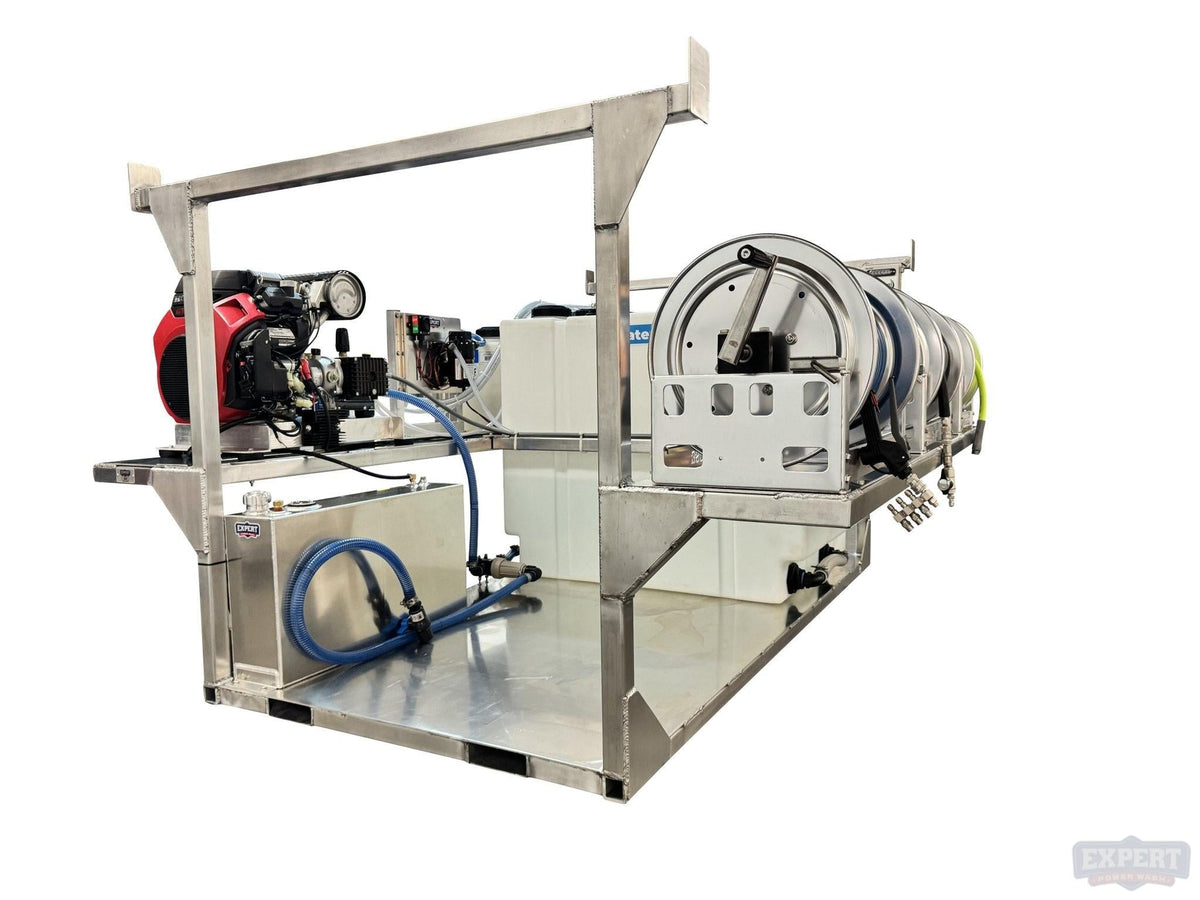
A pressure washing skid has one job: hold hundreds of pounds of machine, tank, reels, and water together while it gets bounced down the road, baked in the sun, and splashed with chemicals every single day. The material it's built from decides how long it does that job — or whether it does it at all.
We ran our own washing operation for over a decade before we started building equipment for other contractors, and in that time we ran just about everything — plywood decks, welded steel frames, aluminum. The one thing we never ran was a poly skid, and once you see the comparison below, you'll understand why we never wanted to.
Still deciding whether a skid is even the right setup for you? Start with our breakdown of skid vs. trailer vs. van, then come back here.
Wood: The Weekend Warrior Special
Plenty of guys start with a plywood platform bolted into a truck bed. It's cheap, it's easy to work with, and for the first few months it seems fine.
Then reality sets in. Wood soaks up water — and this is a business where everything gets wet, all day, every day. Add sodium hypochlorite overspray and you've accelerated the process. Decks rot from the underside where you can't see it, mounting bolts crush and loosen as the fibers soften, and the whole platform warps until nothing sits flat anymore. A wood skid isn't a build; it's a countdown.
Verdict: Fine for a season. Not a foundation for a business.
Steel: Strong, Heavy, and Rusting From Day One
Steel is genuinely strong — no argument there. But it comes with two problems that never go away.
It rusts. Constantly. You're spraying water and chlorinated chemicals around a steel frame for a living. Powder coat and paint help until the first rock chip or scratch, and then corrosion starts underneath where you can't stop it. Welds, bolt holes, and drain points go first. Give it a few years of SH exposure and a steel skid is flaking apart at exactly the points that matter — the structural ones.
It's heavy. Really heavy. Steel weighs roughly three times what aluminum does. That's payload you can't spend on water, a bigger machine, or a second reel. It's worse fuel economy every mile, more wear on your truck or trailer axles, and less margin under your GVWR. You're paying for that weight every day you own it, and it's not buying you anything.
Verdict: Strong on day one, but it's fighting a corrosion battle it will eventually lose — and making your truck carry the extra weight the whole time.
Poly: Rust-Proof, but Soft Where It Counts
Molded plastic skids solve the corrosion problem — plastic doesn't rust, and it doesn't care about SH. That's real, and it's why they've gotten popular. They're also cheaper to produce, which shows up in the sticker price.
But a skid's job is structural, and plastic is not a structural material:
- It creeps. Under constant load — like a 65-gallon buffer tank holding 500+ lbs of water — plastic slowly deforms, especially in summer heat. Panels bow, mounting points shift, and the unit gets spongy.
- It can't take heat. Hot water machines and burners will soften and warp poly. Even engine and pump heat in an enclosed van adds up. Aluminum doesn't care; plastic does.
- Mounting is the weak link. You're threading into molded-in inserts, and after a few thousand miles of vibration, those are the first things to strip or pull out. There's no good field fix.
- You can't repair it. Crack a molded shell and your options are a weak plastic weld or replacing the whole thing.
Verdict: Solves rust, but trades away rigidity, heat tolerance, and repairability — the things a working skid needs most.
Aluminum: The Material That Does It All
Here's why aluminum ends up as the answer once you've lived with the alternatives:
- It doesn't rust. Aluminum forms its own protective oxide layer — it's the standard for boat trailers, docks, and marine hardware that live in saltwater. It handles daily water and chemical exposure without paint or coatings to maintain.
- It doesn't rot, warp, creep, or soften. A welded aluminum frame stays square under a full buffer tank, in August heat, next to a burner, for the life of the rig.
- It's light. Around a third the weight of steel at comparable strength, which means more payload for water and equipment, easier towing, and breathing room under your weight ratings.
- Everything mounts to structure. Want to add a reel, a jug rack, or reconfigure your pump setup two years in? Drill and bolt into frame. It holds.
- It's repairable — forever. Any competent welder can fix aluminum, and the repair is as strong as the original. Your skid never has an expiration date.
- It holds resale value. When it's time to upgrade, a straight, solid aluminum frame is an easy sell. Rotted wood, rusted steel, and chalked plastic are not.
Not All Aluminum Is Equal
One caveat, and it matters: "aluminum" on a spec sheet can mean a lot of things, and thin, low-grade material will disappoint you. We build exclusively with the highest grade-A, aircraft-grade aluminum — and we inspect and refuse stock that doesn't meet our standards, because a frame is only as good as the metal in it. Whoever you buy from, ask what grade and thickness of aluminum is in the build. If they can't answer, that's your answer.
Side by Side
| Wood | Steel | Poly | Aircraft-Grade Aluminum | |
|---|---|---|---|---|
| Water/chemical exposure | Rots | Rusts | Immune | Naturally corrosion-resistant |
| Stays rigid under load | Warps | Yes | Creeps and bows | Yes |
| Heat tolerance | Fire risk near burners | Excellent | Softens and deforms | Excellent |
| Weight | Moderate | Very heavy | Light | Light |
| Field repairs | Patch jobs | Weldable (then rusts at the weld) | Nearly impossible | Weldable anywhere, permanently |
| Lifespan in daily use | 1–2 seasons | 3–5 years before rust wins | Degrades with heat and load | Life of the rig |
| Resale value | None | Low | Low | Strong |
The Honest Bottom Line
A quality aluminum skid costs more up front than plywood, steel, or plastic — we're not going to pretend otherwise, and we're not always the cheapest option out there. But look at cost-per-year instead of sticker price. A skid you replace every few seasons costs more than one that's still square and solid in year ten, and that math doesn't even count the downtime while you rebuild. (If you're budgeting a full rig, we broke down real numbers in our guide to what a pressure washing trailer costs.)
Our advice, whoever you buy from: don't shop the price tag, shop the build. Ask what the frame material is, what grade it is, how components are mounted, how it handles heat, and what happens when something breaks. The answers will tell you everything.
Questions About Your Setup?
Every skid we build is welded from grade-A aircraft-grade aluminum, built in-house in Oregon City, and configured around how you actually work. Browse our custom skid builds, check what's available today in Ready Now Builds, or book a free discovery call — we're happy to talk through your build, no pressure.


