



Short answer: Cold water handles most residential work — house washing, roofs, fences, and typical driveways — because on those jobs the chemistry does the cleaning, not the temperature. Hot water earns its money on grease, oil, and gum: restaurant pads, drive-thrus, dumpster areas, gas stations, parking garages, and fleet washing. If your plan is commercial flatwork, hot water pays for itself fast. If your plan is house washing, keep the money.
Adding hot water to a rig is one of the bigger checks you'll write when building out a pressure washing business — anywhere from about $4,000 for a hot box up to $9,000–$15,000 for a dedicated hot water machine. Before we built rigs for other companies, we ran our own washing operation for over a decade, with both cold and hot setups on our trailers and skids. So here's the honest breakdown of when hot water is worth it and when it's an expensive feature you'll rarely fire up.
What Hot Water Actually Does
Heat changes the physics of cleaning in a few specific ways:
- It cuts grease and oil. This is the big one. Hot water (typically 180–250°F at the burner) emulsifies petroleum-based grime the way hot water cuts bacon grease on a pan and cold water doesn't. Degreasers work dramatically better with heat behind them.
- It removes gum. Chewing gum on concrete releases almost instantly under hot water. With cold water, you're grinding at it with a turbo nozzle and still leaving shadows.
- It speeds up almost every job. Heat accelerates the chemical reactions your detergents rely on, which means fewer passes and faster production rates on flatwork.
- It keeps you working in winter. In cold months, hot water lets you keep washing when cold-water outfits park their rigs — and it reduces the flash-freeze risk on the surfaces you're cleaning.
What hot water does not do is replace chemistry. Organic staining — algae, mildew, moss on siding and roofs — is killed by sodium hypochlorite and surfactants, not temperature. That distinction is the whole buying decision.
Where Hot Water Earns Its Money
- Restaurant and food-service concrete — dumpster pads, grease dumpster areas, back-of-house pads, drive-thru lanes. These jobs are nearly impossible to do well with cold water, and they recur monthly or quarterly. This is the classic hot water contract work.
- Gas stations and fuel islands — oil drips and diesel staining respond to heat plus degreaser in a way cold water can't touch.
- Parking lots and parking garages — large commercial flatwork was where we focused our own washing business, and heat plus a surface cleaner is what makes the production rates (and the margins) work on oil-stained concrete.
- Fleet and heavy equipment washing — road film, grease, and hydraulic residue come off far faster hot.
- Gum removal — storefronts, sidewalks, transit areas.
- Cold-climate operations — if you want year-round revenue in a real winter, hot water extends your season.
Notice the pattern: every one of these is commercial, recurring, and priced higher than residential work. That's why hot water pays for itself quickly for the right business — the equipment cost is real, but so are the contracts it unlocks.
Where Cold Water Is All You Need
- House washing and soft washing. Siding, stucco, and gutters are cleaned by SH and surfactant dwelling on the surface. Heat adds nothing here worth paying for.
- Roof washing. Pure chemistry, low pressure. Temperature is irrelevant.
- Typical residential concrete. A driveway with dirt and organic staining cleans up fine with cold water, a pre-treat, and a surface cleaner. Oil spots get a degreaser and a post-treat.
- Wood fences and decks. Low pressure and the right cleaners — heat can actually work against you on wood.
If this list describes the business you're building, a well-built cold water rig with a properly sized machine is the smarter spend. Put the hot-water money into a bigger machine, a second reel, or your soft wash system instead — those will make you money on every job, not just the greasy ones. (If you're still deciding on machine size, start with our guide on 4 GPM vs. 5.5 GPM vs. 8 GPM.)
Two Ways to Get Hot Water
1. A dedicated hot water pressure washer
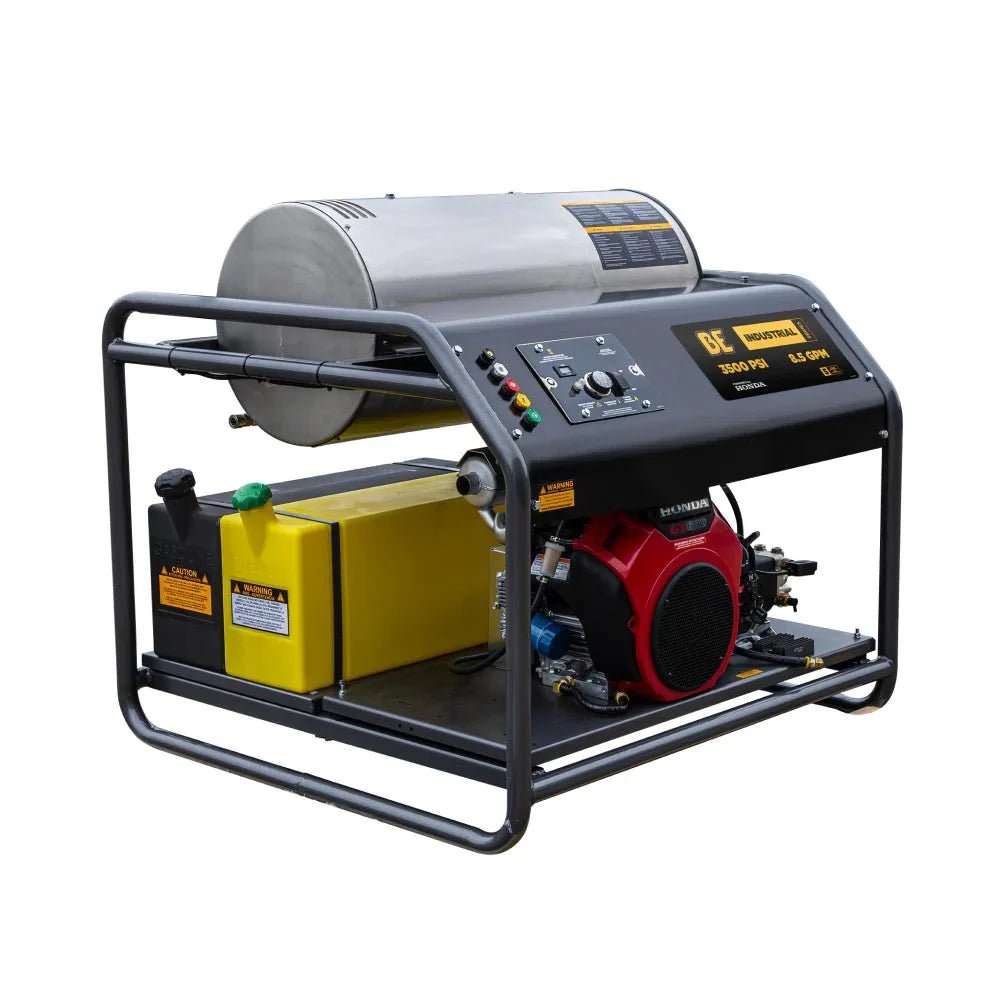
A dedicated hot water machine — usually a hot water skid — is an all-in-one system: engine, pump, burner, and coil built as a single unit. It's the cleanest install on a trailer or skid and the most common route on purpose-built hot rigs. Most dedicated hot water skids on the market run $9,000–$15,000 depending on GPM, pump, and burner setup. Ours sit at the value end of that range:
- 4,000 PSI / 5.5 GPM hot water machine (Honda GX690, CP pump) — $8,000
- 3,500 PSI / 8.5 GPM hot water machine (Honda GX690, AR pump) — $8,199
- BE 8 GPM hot water machine (Honda GX690, General pump) — $9,499
2. Adding a hot box to a cold water machine
A hot box is a standalone diesel-fired burner that sits inline after your existing cold machine. Your cold water machine does the pumping; the hot box adds the heat. It's the right move when you already own a good cold machine and want to add hot capability without replacing it:
One machine, one gun, one burner — that's the correct way to plumb it. And if you'd rather skip piecing it together, our Hot Eagle dual axle trailer is the turnkey version: a complete hot water trailer built on aircraft-grade aluminum, ready to work. (For full trailer pricing context, see what a pressure washing trailer costs.)
Cold vs. Hot at a Glance
| Option | Typical Cost | Best For | Trade-Offs |
|---|---|---|---|
| Cold water machine | $2,500–$5,000 | House washing, soft wash, roofs, residential concrete | Slow or ineffective on grease, oil, and gum; seasonal in cold climates |
| Hot box add-on | $4,000–$4,500 | Adding hot capability to a cold machine you already own | Extra footprint and weight on the rig; two units to maintain |
| Dedicated hot water skid | $9,000–$15,000 | Commercial flatwork, restaurant pads, fleets, year-round work | Higher upfront cost; burner fuel and coil maintenance |
| Turnkey hot trailer | $31,000+ | Starting or scaling straight into commercial hot water work | Biggest check up front — but everything is built, plumbed, and warrantied as a system |
What Hot Water Costs After You Buy It
Be honest with yourself about the ongoing costs, because they're real:
- Diesel for the burner. Plan on roughly a gallon or more of diesel per hour of burner run time. On all-day flatwork, that's a line item on every job.
- Coil maintenance. Heating coils scale up over time, especially with hard water, and periodic descaling (or eventual coil replacement) is part of ownership.
- More components, more weight. A burner, fuel tank, and coil add several hundred pounds and more parts that can fail — which matters for trailer capacity and axle choices.
None of this is a reason not to buy hot — it's a reason to buy hot when the work justifies it, and to build it on a platform that can carry it properly.
Our Honest Take
In our decade-plus of running our own washing company, hot water wasn't where we started — it's what the work demanded as we moved into large commercial flatwork: parking lots, parking garages, multifamily, and senior living. On that work, hot water plus a surface cleaner is the combination that makes the production rates work. If that's the business you're chasing, buy hot and don't look back.
But we've also watched plenty of new operators spend five figures on a hot water skid to wash houses, where it earns them nothing a cold machine wouldn't. The right question isn't "is hot water better?" — it's "who are my customers?" Grease, gum, oil, and winter mean hot. Siding, roofs, and chemistry mean cold is plenty.
And as always: whether you buy from us or not, buy hot water equipment that's built to carry it. A burner, fuel tank, and coil add serious weight, and a rig that wasn't engineered for it will show you where the corners were cut. We may not be the cheapest option — we build exclusively with the highest grade-A aircraft-grade aluminum, and we plumb hot systems the way we'd want them on our own rig — but cutting corners on the front side only costs you on the backside.
Talk It Through Before You Buy
If you're weighing cold vs. hot for your build, that's exactly what our discovery calls are for. We'll ask about the work you're going after and tell you straight whether hot water belongs on your rig.
- Book a free discovery call
- Call the shop: 503-403-6185
- Browse our custom builds and pressure washers
- Not sure which platform fits? Start with Skid vs. Trailer vs. Van


