



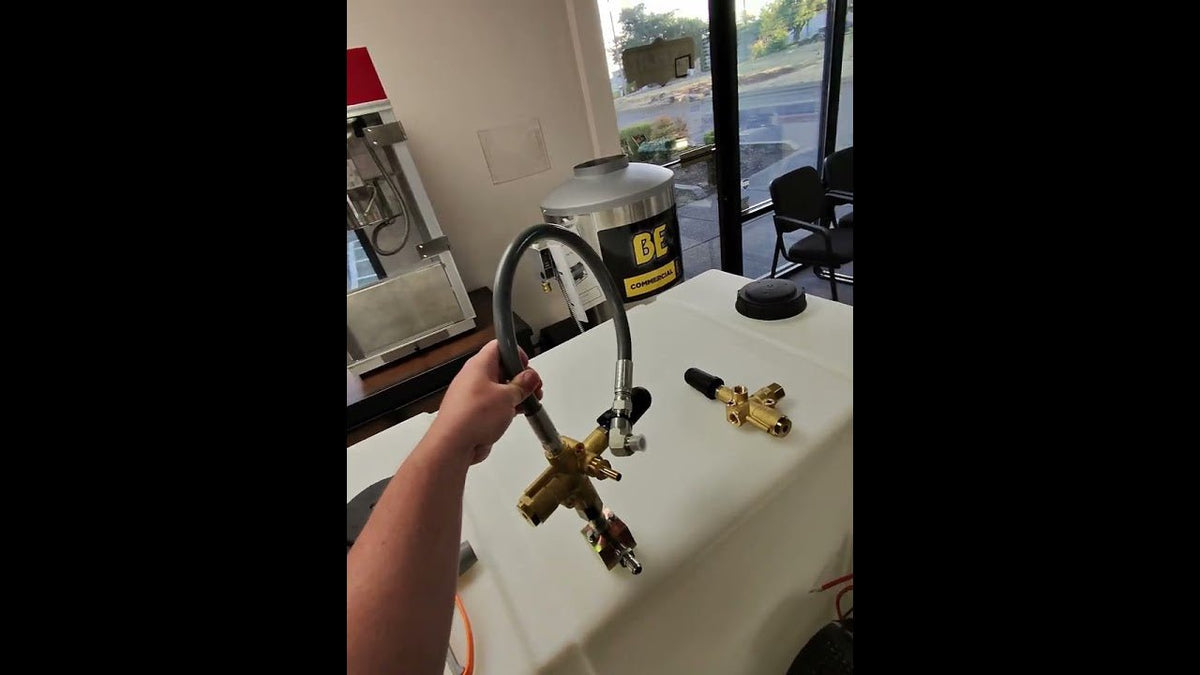
Walk up to almost any commercial pressure washer as it comes from the factory and the unloader is screwed straight into the pump head on a short 3/8 nipple. It works. It also spends every minute the engine runs shaking on the end of that nipple, and over enough hours something gives: the nipple cracks, the fitting weeps, or the unloader body itself fails. When a customer rolls in with a pump problem, this is one of the first places we look.
We stopped building machines that way years ago. Every 8 GPM and 5.5 GPM machine we put on a skid or trailer has the unloader moved off the pump and onto a block. The video above shows two 8 GPM machines side by side, one belt drive and one gear drive, same Honda engine and same pump, so you can see exactly what changes.
What block mounting is
Instead of hanging the unloader off the pump, we thread it into a solid mounting block that bolts to the machine's base plate, or anywhere on the skid or trailer frame that makes sense for the plumbing. A short high-pressure whip line connects the pump outlet to the block. The pump still vibrates. The unloader does not, because it is no longer attached to the thing that is vibrating.
Two other things change at the same time. First, the whip line from pump to unloader is upsized: 1/2 inch hose instead of the 3/8 the machine came with, with a custom 3/8-to-1/2 adapter at the pump. The bigger line is less restrictive, so the pump is not working against the plumbing between it and the unloader. Second, every hose in that loop is custom crimped to length with a swivel end, so it goes on without a twist in it and comes off with a wrench when it needs service.
The bypass stays 3/8. On an 8 GPM machine that is plenty, and it goes back to the buffer tank the same as before.
Flow-sensitive vs. trapped-pressure unloaders
This is the other half of the decision, and it is a bigger deal than where the unloader sits.
Most machines ship with a trapped-pressure unloader: a VRT3, a K7, something in that family. When you let off the trigger, the unloader kicks into bypass but holds the line at pressure, so the hose stays stiff and the next trigger pull hits with a spike. Dragging 200 feet of pressurized hose around a house all day is real work, and every one of those spikes is wear on the gun, the hose, and the pump.
A flow-sensitive unloader like the General Pump Pulsar senses when flow stops and lets the line pressure bleed off gently instead of trapping it. The hose goes soft the moment you release the trigger. It is easier on the equipment and much easier on the person pulling the hose. We ran both types for years on our own rigs, and this is where we landed.
The reason you do not see Pulsars everywhere is price. The unloader alone is around $300, versus $75 for a VRT3. Most builders assume you will not pay for it, so they do not offer it. We think it is one of the best upgrades on the machine, so it is standard on our Honda GX690 8 GPM gear drive and GX630 5.5 GPM gear drive builds.
If you run a WaterBoss 750, this is not optional
The WaterBoss 750 Special has become a very popular downstreaming gun, and it cannot live behind a trapped-pressure unloader. The pressure spike on every trigger pull is more than the gun is built to take. If you want to run that gun on a pressure washer, you need a flow-sensitive unloader in front of it. We have seen enough people buy the gun, put it on a stock machine, and then wonder why it did not last.
The retrofit kit
For years the conversation went like this: someone would see our setup, buy a Pulsar from us, then spend a week at a hydraulic shop trying to find a 1/2-to-3/8 adapter, get a whip line made that turned out to be the wrong length, and call us back to talk through it over the phone. So we put everything in a box.
The Pulsar Unloader Block Mount Complete Kit has the mounting block, the 1/2-to-3/8 pump adapter (a hard fitting to find on its own), the 3/8 bypass, the custom-crimped swivel whip line already sized for this setup, and the Pulsar unloader. It fits both gear drive and belt drive machines. The only decision left for you is where to bolt the block. On the base plate near the pump is the most common spot; on a skid or trailer you can put it wherever the plumbing runs cleanest.
Setting it up after installation
Once the unloader is on the block, it still has to be adjusted with the right nozzle on the gun and a gauge in the line, not by feel. We wrote that procedure up separately: How to Adjust Pressure on a Pressure Washer (Unloader Valve) the Right Way. Read that before you touch the adjustment screw, because over-tightening a flow-sensitive unloader is the fastest way to turn it back into a trapped-pressure one.
Parts mentioned
- Pulsar Unloader Block Mount Complete Kit — everything in this article in one box
- Pulsar PLSRZ2140 Flow Sensitive Unloader — the unloader by itself
- Unloader mounting blocks — 3/8 and 1/2 in nickel-plated or brass
- K7 series unloaders and VRT3 unloader — trapped-pressure options, if that is what your setup calls for
- All pressure washer unloaders
Further reading
- How to Adjust Pressure on a Pressure Washer (Unloader Valve) — The Right Way
- Mastering Downstreaming with a Pressure Washer
- Pressure Washing Rig Maintenance Guide: Skids, Trailers, and Vans
Not sure which unloader your machine has or whether the kit fits it? Call the shop at 503-403-6185 (landline, no texts), Monday through Thursday, 8am to 4pm, or bring the machine by 13896 S Fir St Suite B in Oregon City, Oregon.


