



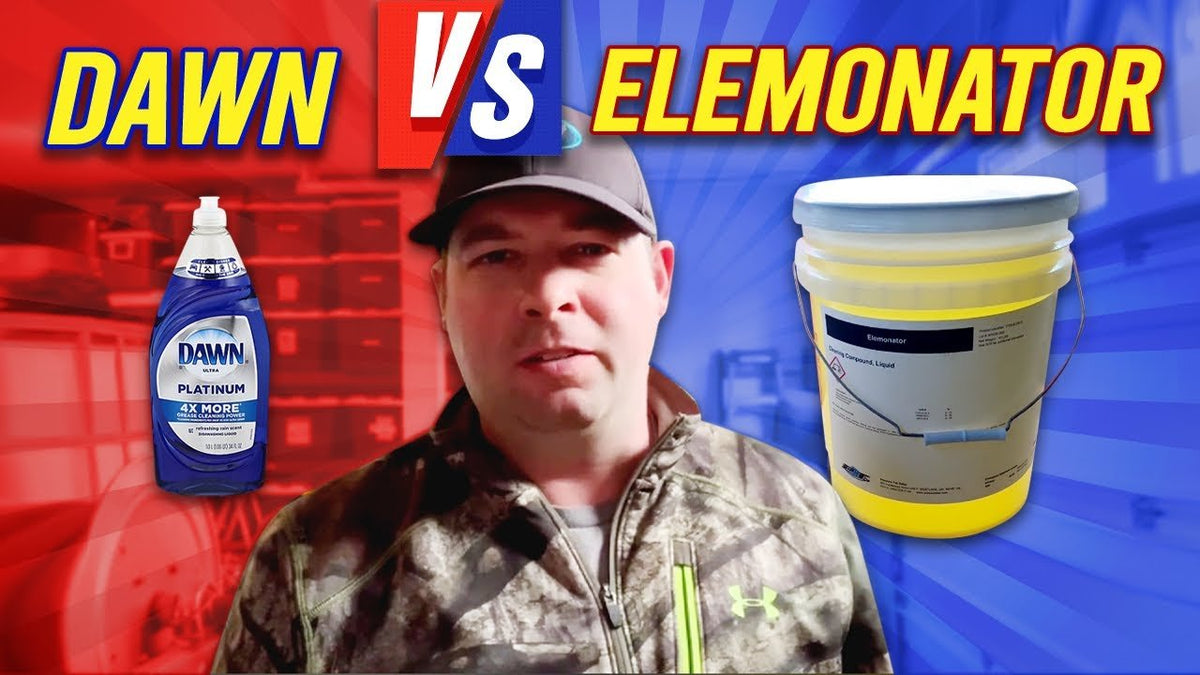
Some context before the argument. What follows started as a video I made years ago, back when I was still running our pressure washing company full time and long before Expert Power Wash was a store. At that point I had nothing to sell you — I was a contractor buying soap like everybody else, tired of watching people defend dish soap in Facebook groups.
The argument still holds. What changed is that after enough years of buying other people's surfactant, we started making our own. More on that at the end.
The argument, then and now
Go into any pressure washing group and somebody is defending dish soap in their soft wash mix. The reasoning is always the same: professional surfactant is expensive, dish soap is cheap, and it works well enough.
Two of those three things are wrong.
Start with the label
Turn a bottle of dish soap over and read the back. It tells you not to add bleach.
That warning is on there for the manufacturer's reasons rather than yours, but it tells you something useful anyway: the product was never formulated to live in sodium hypochlorite. It was formulated for a sink.
In a soft wash mix that means your surfactant and your SH are working against each other. A bleach-stable surfactant is built to hold up in hypochlorite and keep doing its job — sticking the mix to the surface, buying you dwell time, letting it cling to a soffit instead of running straight off.
A dish soap in the same tank does the opposite. Depending on the soap it can curdle on contact with SH, leaving white residue that is miserable to flush out of a system and streaks the surface on the way. Worse, most dish soaps immediately start attacking the hypochlorite itself. The 12.5% you loaded can be down near 6% within minutes, and you are now washing with half the mix you thought you had.
Can you clean a house that way? Yes. Plenty of people do. They are just doing it with a weaker mix than the one in the tank, and making up the difference with more SH or more passes.
Now the math, which is the part that surprises people
The comparison people make in their head is bottle price against bucket price. Four dollars versus a hundred and seventy five. Of course the four dollar option looks cheaper.
That is the wrong comparison. Price both per ounce.
Our surfactants, at the time of writing:
- 5 gallon — $175 for 640 oz = 27.3¢ per ounce
- Case of 4 gallons — $160 for 512 oz = 31.3¢ per ounce
- Single gallon — $49 for 128 oz = 38.3¢ per ounce
Now do the same with whatever is under your kitchen sink. Shelf price divided by the ounces on the bottle. A 16 oz bottle at $4 is 25¢ an ounce. At $5 it is 31¢ an ounce.
You are within a few cents either way — and if you are buying surfactant in five gallon pails, you are very often under the per-ounce cost of retail dish soap.
Run it out to a job. At five ounces of surfactant in a house wash mix, the difference between the two is pennies per house. Not dollars. Pennies. That is the entire financial case for using a product that is actively degrading your mix.
And that is before you count the drive to the store and the shop time it burns, instead of pulling a pail off your own rack.
The third thing: how it rinses
The reason I stopped experimenting and settled on a professional surfactant was not price. It was rinsing.
A surfactant that rinses clean is the difference between a finished job and a callback. Dish soap is engineered to hold onto grease and to foam in standing water, neither of which is what you want on vinyl siding. It can leave film, and film on glass is what the customer notices after you have driven away.
One caveat that applies to every soap including ours: never leave mix sitting on hot glass in summer sun. That will mark windows no matter what is in the tank. That is a technique problem, not a product problem.
What changed since then
For years I was buying professional surfactant by the pail, paying freight on it out to Oregon, and being glad it worked.
When we opened the store and started building equipment, we finally had the volume and the supplier relationships to make our own instead. So we did. Everything we learned washing houses about what a surfactant actually has to do — stay stable in hot bleach, cling long enough to work, rinse without film, and not smell like a pool deck — went into the line we sell now.
All of it is bleach stable, all of it is scented, and all of it is the same price:
- Apple Suds — our original and still the one most crews reorder. The default house wash and roof surfactant.
- Lemon Suds — same formula, cleaner citrus scent. A lot of guys prefer it on residential where the homeowner is standing right there.
- Cherry Suds — the third scent option, for crews who want their rig to smell like something other than everybody else's.
- Apple Cadabra — a bleach marker as well as a surfactant. It colors the mix so you can see exactly where you have already been, and covers the SH smell while you work. On a big roof or a long two-story run, being able to see your coverage is worth more than it sounds.
All four are $49 a gallon, $175 for five gallons, or $160 for a case of four.
Do not take our word for any of it. The surfactant sample pack is $15, or the variety pack gets you a gallon of each to run on real jobs before you commit to a pail.
Where we will give ground
There are good surfactants made by a lot of companies, and ours is not the only one worth buying. If you already have a bleach-stable soap you like and it rinses well, keep using it. The argument here was never brand against brand.
The argument is that "dish soap is cheaper" does not survive a calculator, and that deliberately choosing a product that fights your sodium hypochlorite is a strange way to run a wash business.
Further reading
- How a Soft Wash Mixing System Actually Works
- Mastering Downstreaming with a Pressure Washer
- Choosing the Right Nozzles for Your 12V Soft Wash System
The full chemicals collection has our surfactants alongside the degreasers, rust removers and wood cleaners we carry. Questions about a mix for a specific surface? Call the shop at 503-403-6185 (landline, no texts), Monday through Thursday, 8am to 4pm.


