



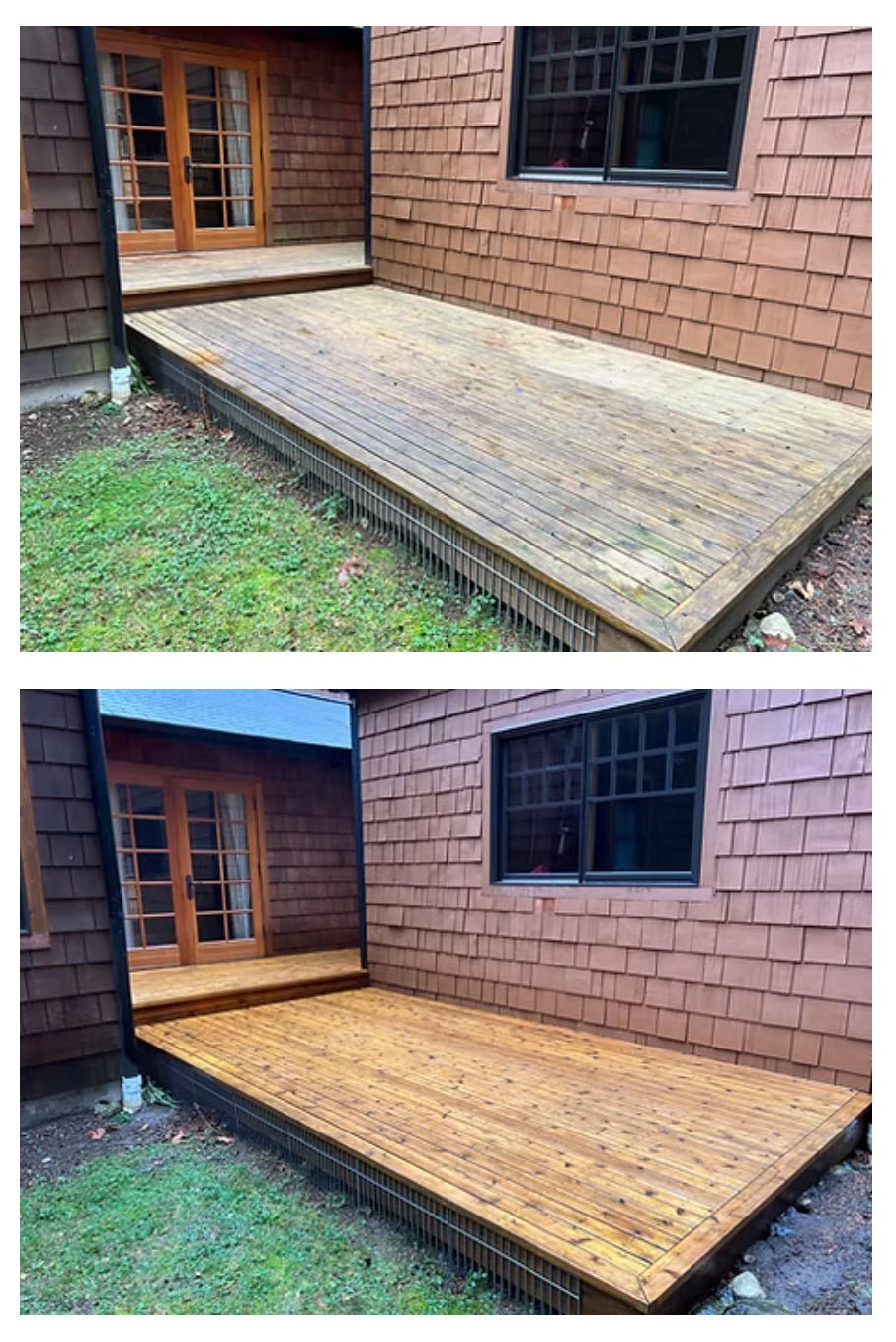
Short answer: ClenzO2 is an oxygen-based (hydrogen peroxide) cleaner that ships with its own activator. You mix the two, spray it on with a pump sprayer or soft wash system, and let it work — no scrubbing, no pressure, and under normal use no rinse. It is the right tool for wood, painted surfaces, work over water, and any customer who says "no bleach." It is not a replacement for sodium hypochlorite on a heavily infested roof or a commercial concrete pad, and we don't sell it as one.
We get a version of the same question at the counter every week: "Somebody asked me for a bleach-free wash — what do I use, and how do I use it?" Before we built equipment we ran our own washing company for over a decade, so we've been on the other side of that conversation. Here's how ClenzO2 works, how we'd apply it on each surface, and how to know when to reach for it instead of your SH mix.
What ClenzO2 Actually Is
ClenzO2 is a hydrogen peroxide cleaner (under 8% by weight) with a separate activator in the box. Once activated, the peroxide oxidizes mold, mildew, algae and other organic staining, and then breaks down into water and oxygen. There is no sodium hypochlorite, ammonia, acid, phosphate or dye in it, and the safety data sheet lists it at zero VOC.
Two facts on the SDS matter on a job site. First, ClenzO2 is listed in the EPA's Safer Choice program and meets the Safer Choice criteria for direct release — the standard for products used outdoors that end up on soil, in storm drains or over water. Second, it is still an eye irritant (Category 2), so goggles and liquid-proof gloves are not optional just because it isn't bleach.
The other thing to understand is that it works differently from SH. Bleach kills organic growth on contact and you see the result while you're still standing there. ClenzO2 keeps reacting after you leave — wood in particular continues to brighten for days — so the job you look at when you pack up is not the finished job.
When ClenzO2 Is the Right Call (and When It Isn't)
- Wood — cedar fences and siding, decks, log homes, shake roofs, docks. Bleach greys the fibers and raises the grain; ClenzO2 cleans without doing either.
- Painted and stained surfaces where a hypochlorite mix can blotch or lift color.
- Bleach-free roof washes — asphalt shingle and tile when the homeowner has asked for no bleach, and the growth is moderate.
- Anything near water — docks, boathouses, bulkheads, pool surrounds, lake and slough frontage where SH runoff isn't acceptable.
- Heavy landscaping — the jobs where you'd otherwise spend half the morning pre-wetting and tarping plants.
- Masonry and stucco with organic staining (moss, algae, mildew) rather than oil or rust.
- Enclosed spaces — crawl spaces, attics, outbuildings, anywhere chlorine fumes are a problem.
Where we'd still run bleach: a badly infested roof the homeowner just wants black-streak-free by tonight, a standard vinyl house wash, and commercial flatwork with deep-set growth. SH is faster on those and the customer isn't paying for bleach-free. Plenty of crews carry both and pick per job — that's how we'd do it.
Step 1: Mix It
Add the included activator to the gallon per the label and blend it thoroughly. Once activated the solution is live for roughly 15 hours, so mix what you'll use that day. Full strength is the default. For light soiling — a deck that's dull rather than black, a fence with a season of mildew instead of five — it can be cut up to 50% with water, which effectively doubles your coverage.
Don't mix ClenzO2 with bleach, surfactants or anything else. It's a one-ingredient system with an activator, and combining it with your SH mix does nothing useful and can react.
Step 2: Choose Your Applicator
- Pump-up sprayer — fine for a section of fence, a small deck, a set of steps, a propane tank. Cheap and simple, but you'll hate it past a couple hundred square feet.
- 12V soft wash system — if you already run a 12V pump for roof washing, ClenzO2 goes through it the same way your SH mix does. Flush the system with clean water first so you're not mixing chemistries in the line. Our article on 12V soft wash pump setup covers the pump side.
- A dedicated ClenzO2 rig — we build two. The ClenzO2 Spray Pod is a compact commercial-grade sprayer built for it, and the ClenzO2 Max is a full roof cleaning skid with a Honda 8 GPM machine for crews doing bleach-free roofs as a service line. Keeping ClenzO2 on its own equipment means no flushing, no cross-contamination, and no wondering what's in the hose.
Whatever you spray it through, keep the surface temperature roughly between 40°F and 100°F. Below that the reaction slows to a crawl; above it the solution flashes off before it has time to work.
Step 3: Apply and Let It Work
Wet the surface evenly from the bottom up so you can see your coverage, then let it sit. You'll see the solution foam as it reacts with organic matter — that's the peroxide releasing oxygen into the growth. Under normal use there is nothing to rinse. The reaction finishes on its own and the next rain carries the residue away. On heavy staining a light rinse after the dwell speeds up the visible result, but you are never pressure washing the surface, which is the entire point on wood and shingles.
Test an inconspicuous spot first, as with any cleaner, and give the customer the expectation up front: the surface will look better today and better still in a few days once it dries out.
Surface by Surface
Decks and fences
This is where ClenzO2 shines. Grey, mildewed cedar comes back to its natural color without the fuzzy raised grain that bleach and pressure leave behind. Apply full strength on neglected wood, let it dwell, and resist the urge to hit it with the wand. If the customer is planning to stain or seal, ClenzO2 is a clean prep step — just let the wood dry fully first.
Roofs
For a bleach-free roof wash, apply from the ridge down with a soft wash system, keep the roof wet through the dwell, and let rain do the rinse. Moderate algae and moss respond well. A roof that is black from eave to ridge is an SH job, and it is better to tell the homeowner that than to under-deliver with the wrong product.
Concrete, steps and walkways
ClenzO2 handles the green and black organic staining on shaded concrete — moss in the joints, algae on north-facing steps. It is not a degreaser and won't touch oil, rust or tire marks. Apply, dwell, and a light rinse gives you a clean surface without the striping a surface cleaner leaves on old concrete.
Tanks, docks and around water
Propane tanks, dock boards, boathouse siding and anything else you'd never spray bleach near: this is the job ClenzO2 was built for. Spray, dwell, walk away.
How Much Do You Need?
Plan on 200–400 square feet per gallon depending on the surface and how bad it is. Porous, heavily stained wood lands at the low end; smoother, lightly soiled surfaces at the high end, and a 50% cut on light work stretches it further. A 400-square-foot deck is one to two gallons. A 1,500-square-foot roof is four to eight, which is where the 5-gallon bucket starts making sense. For crews running bleach-free as a regular service line, we can special-order it by the 275-gallon tote — call the shop for lead time.
Our Honest Take
We don't think ClenzO2 replaces bleach, and we'd be suspicious of anyone who says it does. What it does is let you take the jobs you'd otherwise walk away from — the cedar-sided house on the lake, the historic deck, the customer with a garden she's prouder of than her roof — and do them without damage or a lecture about her hydrangeas. Bleach-free requests go up every year. Having a gallon on the truck turns "sorry, we don't do that" into a yes.
Get ClenzO2
- ClenzO2 1 gallon with activator — ships from Oregon City, or pick it up in store Monday through Thursday, 8am–4pm
- ClenzO2 5-gallon bucket — the crew size
- ClenzO2 Spray Pod and ClenzO2 Max roof cleaning skid — purpose-built applicators
- Browse our soft wash equipment or call the shop: 503-403-6185


